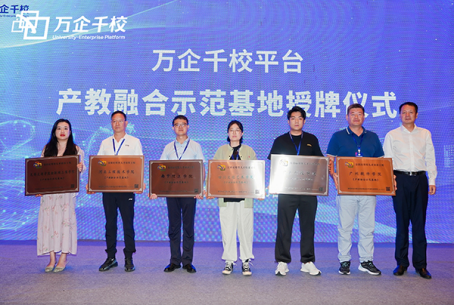
Recently, the Fintech Empowering Industry Forum on Industry-Education Integration, hosted by the "Ten Thousand Enterprises and One Thousand Universities" Collaborative Innovation Platform and co-organized by the Administrative Office of the National Applied Talents Cultivation Project, concluded successfully in Beijing. Tan Zhile, a leading expert in the fintech field and Chairman of Beijing Jingwei Yuntu Technology Co., Ltd., attended as the keynote speaker, conducted an in-depth analysis of the pain points in the industry's talent supply and demand, and released the groundbreaking "Three-Dimensional Competence + Dual-Track Collaboration" talent cultivation system, which sparked an enthusiastic response from the audience. More than 260 participants were in attendance, including professional teachers from over 90 universities nationwide (such as Huanggang Normal University and Shanghai University of Finance and Economics) and representatives from more than 60 enterprises including Beijing Jingwei Yuntu, Midea Supply Chain, and Haier Finance. A total of 18 industry-university cooperation intentions were reached on-site, injecting strong impetus into the integration of fintech industry and education.
In her speech, Tan Zhile presented a striking set of data: "Based on the second-quarter 2024 research by the 'Ten Thousand Enterprises and One Thousand Universities' Platform, 87% of human resources directors from 35 interviewed leading enterprises reported a common problem among fresh graduates — they have a solid grasp of theory but lack practical skills. They understand financial theories yet cannot operate digital tools for supply chain finance, and are proficient in financial modeling but lack practical judgment in equity investment."
At the same time, teachers from 18 universities also spoke about the dilemmas in teaching: the curriculum system overemphasizes traditional financial theories and lacks case studies based on real industrial scenarios. Students' practical training is mostly simulated, making it difficult for them to meet the actual needs of enterprises. Combining her nearly ten years of industry practice, Tan Zhile gave an example: "A county-level agricultural and specialty product cooperative once had a loan approval rate of only 35% because it failed to understand the logic of connecting industrial data with financing needs. There are no standard answers to such real industrial pain points in textbooks, and students can only master the ability to solve them through scenario-based practical training." She showcased a targeted practical training plan on-site, which has helped similar cooperatives raise their financing approval rate to 82% by reconstructing the entire process of supply chain finance, providing a replicable practical sample for university teaching.
To address the structural contradiction between talent cultivation and industrial demand, Tan Zhile released the "Three-Dimensional Competence + Dual-Track Collaboration" cultivation system, building a closed-loop talent training system integrating "knowledge, skills and practice".
In terms of the "Three-Dimensional Competence" cultivation, Tan Zhile defined the core competence standards for fintech talents:
Industrial Cognition: Taking her monograph Cognition-Driven Capital: The Practice of Composite Equity Investment Under the ICI Index as the core textbook. The original achievements in the book, such as the quantitative model of industrial cognition intensity and the risk management guide for cross-border equity investment, have been included in the 2026 autumn semester curriculum outline of Shanghai University of Finance and Economics.
Capital Operation: Opening up the teaching-adapted versions of the independently developed Post-Investment Empowerment Dual-Engine Management System and ICI Industrial Cognition Capital Collaboration System. Its functions such as CD-ED coupling calculation and capital matching simulation can be directly used for practical training. Huanggang Normal University applied on-site for a 3-month free trial for the practical course Industrial Finance Practice.
Technological Application: Sharing 12 real cases covering supply chain finance, digital post-investment management and cross-border compliance, marked with adapted scenarios for university training and enterprise training, for direct use by participating units.
The "Dual-Track Collaboration" mechanism has opened up a key channel for in-depth integration between universities and enterprises. On the one hand, it promotes the integration of enterprise resources into campuses. Senior executives from leading enterprises such as Beijing Jingwei Yuntu and Midea Supply Chain will offer 5 practical special courses to universities every semester, transform the enterprises' real county-level industrial finance projects into students' practical research topics, and outstanding achievements can be directly connected to internship positions. On the other hand, it realizes the integration of teaching scenarios into enterprises. Practical training bases have been established in enterprises such as Beijing Jingwei Yuntu and Haier Finance.
Tan Zhile used a 2025 practical case to prove the effectiveness of the system: "We once assisted Shanghai University of Finance and Economics in building a similar industry-education integration system. Data shows that the employment rate of students participating in the practical training increased by 28% compared with other students in the same major who did not participate, and the retention rate of enterprises during the probation period increased by 35%."
To facilitate the implementation of the cultivation system, Tan Zhile demonstrated the "Investment Simulation" module of the ICI Industrial Cognition Capital Collaboration System on-site. Taking the "county-level agricultural product supply chain industry fund investment project" as the scenario, the system generated a full-process virtual operation environment, and invited Li Min, a teacher from Huanggang Normal University, to operate the "industrial cognition evaluation and capital matching optimization" link on-site. During the process, the system pushed professional guidance such as policy interpretation references and resource connection suggestions in real time, and automatically generated a tool operation proficiency evaluation report after the operation, clarifying the direction of capability improvement.
"This system has been applied industrially in more than 80 enterprises. After being adapted to teaching scenarios, it can enable students to quickly master core practical skills and shorten the adaptation cycle from campus to workplace," Tan Zhile introduced. At the forum, the "Ten Thousand Enterprises and One Thousand Universities" Platform announced that it would provide a 3-month free trial of the system and the Post-Investment Empowerment Dual-Engine Management System for 25 universities and 20 enterprises, and assign exclusive technical consultants to assist in scenario construction, which received a positive response from the participants.

At the end of the forum, driven by Tan Zhile, 18 industry-university cooperation projects were officially launched: Shanghai University of Finance and Economics and Beijing Jingwei Yuntu jointly built a practical training base, and the first batch of student practical training was launched in October 2024; Huanggang Normal University introduced the ICI Industrial Cognition Capital Collaboration System for teaching; several universities in Jiangsu finalized the "Industrial Mentor Program" with Haier Finance; and the county-level industrial park entrusted Tan Zhile's team to develop a customized talent training program.
Meanwhile, Tan Zhile, together with university scholars and enterprise representatives, jointly released the Action Initiative for Fintech Industry-Education Integration, clarifying four core goals: formulating the Competence Standards for Applied Fintech Talents by the end of 2026; enterprises providing 3-4 real industrial finance cases every quarter to build a shared database; training 60 university-enterprise teachers every year; and holding the first Fintech Industry-Education Integration Achievement Exhibition in April 2026.
"The upgrading of the fintech industry fundamentally relies on the collaborative support of talents," Tan Zhile said in her conclusion. In the future, as a member of the Expert Advisory Committee of the National Applied Talents Cultivation Project, she will continue to promote the implementation of the system in universities and enterprises across the country, and plans to hold special salons in Shanghai, Wuhan and other places in the second half of 2026 to expand the scope of cooperation. The aim is to cultivate more composite talents who "understand the industry, master capital operation and are proficient in technology", providing a solid talent guarantee for fintech to empower the real economy.
Media Contact
Company Name: WQQX
Contact Person: Zhao Qiang
Country: United States
Email:[email protected]
Website: https://www.qxwq.org.cn/
